

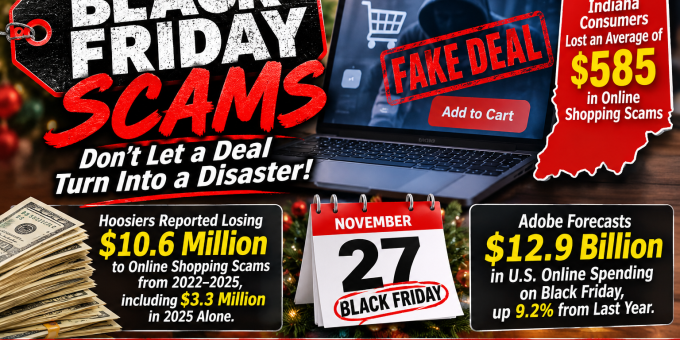
INDIANA — As holiday shoppers prepare to spend billions online this Black Friday, new research warns that Indiana consumers face an average loss of $585 when targeted by online shopping scams.
While Indiana fares better than most states in overall fraud rates, Hoosiers still reported losing $10.6 million to online shopping scams between 2022 and 2025—including $3.3 million in 2025 alone—according to an analysis of Federal Trade Commission (FTC) data by consumer comparison site WhatAreTheBest.com.

With Black Friday falling on Nov. 27 and Adobe forecasting $12.9 billion in U.S. online spending on that single day—up 9.2% from last year—experts warn that rushed bargain hunters are prime targets for fraudulent websites.
How Indiana Compares Nationally and Regionally
Despite the multi-million-dollar toll, Indiana ranked near the bottom nationally for per-capita scam losses and report rates:
- Average Loss: Indiana’s $585 average loss per scam report in 2025 was the seventh-lowest in the nation and 31.5% below the 50-state average of $854.
- Per-Capita Losses: Between 2022 and 2025, Hoosiers lost $153,817 per 100,000 residents—the second-lowest rate in the country (ranking 49th) and 42.5% below the national rate of $267,428.
- Report Frequency: Indiana residents filed 27,422 FTC reports between 2021 and 2025, translating to 398.1 reports per 100,000 people (38th nationally, and 11.8% below the national rate of 451.3). In 2025 alone, Indiana logged 81.5 reports per 100,000 residents, up 5% from 2024.
Regionally, Indiana experienced lower scam report rates than neighboring Illinois (455.2 per 100,000 residents, 23rd), Michigan (432.3, 29th), and Ohio (428.6, 31st), edging out only Kentucky (397.9, 39th).
Younger Shoppers Face High Risk
Albert Richer, founder of WhatAreTheBest.com, noted that while many assume older adults are the primary victims of online fraud, FTC data shows younger buyers are frequently caught off guard. Nationally in 2025, 87.3% of reports from shoppers aged 19 and under involved a financial loss, compared to 69.2% for those 80 and older. Shoppers in their 40s reported the highest total dollar losses nationwide at $59.6 million.
“This goes to show that anybody can fall victim to an online scam, especially around busy shopping periods like Black Friday and Christmas shopping because this is when people tend to let their guard down in the rush, which is exactly when scammers will strike,” Richer said.
Three Quick Checks Before You Buy
Because scammers routinely clone legitimate brand logos, product photos, and layouts, Richer urges Indiana shoppers to pause and complete three quick checks before purchasing from an unfamiliar online store:
- Vet the Retailer: Search the store’s name online alongside the words “scam” or “reviews,” and verify that the website lists a physical address, a working phone number, and a clear return policy.
- Question Steep Discounts: If a site is offering a high-demand item for drastically less than every other major retailer, treat the price as a red flag.
- Use Protected Payment Methods: Always pay with a credit card rather than a bank transfer, wire transfer, gift card, cryptocurrency, or peer-to-peer payment app. Keep screenshots of the product page, order confirmation, and seller messages until your package arrives.
Anyone who suspects they have been scammed should contact their bank or credit card issuer immediately and file a report with the FTC to help alert other consumers.