

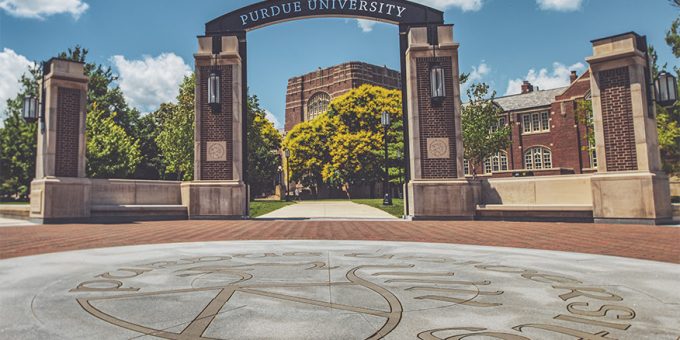
WEST LAFAYETTE — Purdue University leads two projects at the forefront of the U.S. Department of Energy’s (DOE) efforts to accelerate the process of scientific discovery by utilizing artificial intelligence.

Purdue is the only university in Indiana to lead a project under the Genesis Mission awards, the DOE’s largest science and technology funding effort. Only 278 projects out of 5,000 covering all 50 states were selected on topics including energy, discovery science and national security research.
The Purdue projects are led by College of Science faculty from the Department of Physics and Astronomy and the Department of Computer Science alongside private, academic and government partners and will be focused on data science and AI.
Dan DeLaurentis, Purdue’s executive vice president for research, said the recognition is a “strong statement about where our faculty stand nationally.

“The selection of two Purdue projects for the Genesis Mission awards underscores our academic progress,” DeLaurentis said. “Successfully using AI to push the rate of scientific discovery can establish a new future in scientific discovery.”
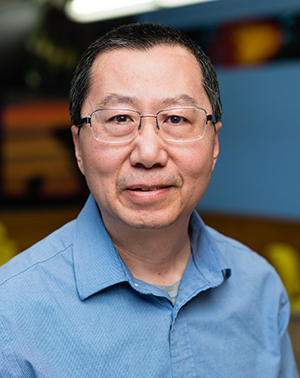

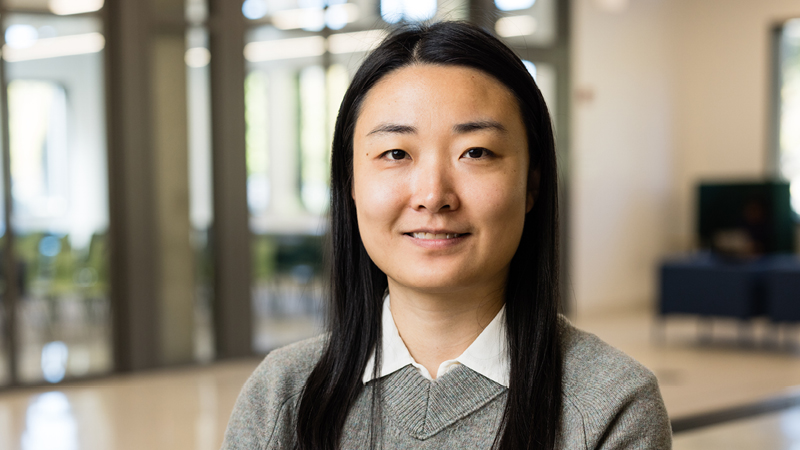
One project led by Wei Xie, professor of physics and astronomy; Miaoyuan Liu, assistant professor of physics and astronomy; and Ruqi Zhang, assistant professor of computer science, will focus on organizing the intense data streams to be generated by the Electron-Ion Collider. This flagship U.S. research facility and the world’s first polarized electron-ion collider is currently under construction.
The team will design and develop autonomous, on-sensor and real-time machine learning models with agentic AI assistance intended to identify important particle interactions and compress data, allowing scientific instruments to recognize which data matters most and minimize data loss.

The second project will be run by David F. Gleich, a professor of computer science. For the research, Gleich will investigate to what extent large language models (LLM) can directly cite their training data. This behavior is important for scientific models so that scientists are aware of the basis of predictions from the AI models.
The project work by Gleich will be done in partnership with the Oak Ridge National Labs. Xie is partnering with Los Alamos National Laboratory and the Fermi National Accelerator Laboratory.
Five other Purdue faculty are part of Genesis Mission awards led by other institutions:
- David Nolte, the Edward M. Purcell Distinguished Professor of Physics and Astronomy, regarding AI workflow for critical minerals in heterogeneous geosystems
- Laura J. Pyrak-Nolte, Distinguished Professor of Physics and Astronomy, in two projects: One involving neural operators for rapid multiphysics simulation of enhanced geothermal systems, and a second focused on a physics-informed multimodal model for fracture evolution in the upper crust
- Xipeng Shen, professor of electrical and computer engineering, regarding an LLM workflow for code generation and optimization on emerging AI accelerators
- Joerg Appenzeller, the Barry M. and Patricia L. Epstein Professor of Electrical and Computer Engineering, regarding Polaris- Angstrom-node equivalent SRAM and logic with polar materials
- Stylianos Chatzidakis, nuclear engineering assistant professor and associate PUR-1 director, involving AI-driven workflow with cyber-assured digital twin for SMRs and microreactors
AI research is a part of the Institute of Physical Artificial Intelligence, a core component of Purdue Computes. The comprehensive Purdue Computes initiative emphasizes four key pillars of Purdue’s extensive technological and computational environment — computing departments, physical AI, quantum science and semiconductor innovation.

