

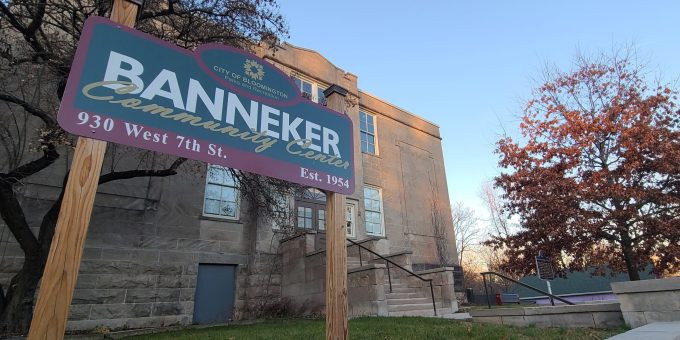
BLOOMINGTON – Two major update and repair projects were recently completed at the Banneker Community Center, 930 W. 7th St., reflecting the Parks and Recreation Department’s commitment to investing in and maintaining facilities for the community.
“Supported by grant funding, these improvements reflect Parks and Recreation’s commitment to maintaining Banneker Community Center as a safe, welcoming, and well-used neighborhood space,” Parks and Recreation Director Tim Street said. “We recognize the role Banneker plays as a place for community programs and events, and protecting its historic character and supporting the programs families and youth rely on is part of our strategy for ongoing community investment.”
The building’s age and significant place in Bloomington’s history necessitate a thoughtful approach to building renovations and repairs. An existing conditions assessment conducted by the Ball State University Center for Historic Preservation in 2025 revealed that water infiltration, primarily caused by insufficient drains and downspouts from more than 8,400 square feet of roof, presented a serious threat to the long-term preservation of Banneker.
In response to the report and the critical need to correct roof drainage problems and make repairs, Banneker staff applied for and received a $20,000 grant from the Indiana Landmarks Black Heritage Preservation Program and proceeded with a contract with B&L Sheet Metal and Roofing to conduct roof, gutter, and downspout repairs. Work on the roof was completed in April for a total of $68,550.
A second project, to replace the original, historic limestone stairs at the main entrance to the building, was completed in March. The Board of Park Commissioners contracted with LRT Restoration Technologies of Monroe, Ohio, to demolish and reconstruct the upper run of limestone steps and knee walls at the main entrance. The steps and masonry were badly deteriorated due to a combination of age and uneven surface wear, and the use of deicing salts, which caused limestone erosion and mortar loss.
A total of 12 existing limestone steps were removed and replaced with new limestone, and 24 limestone blocks in the knee walls were replaced with new limestone. All new joints and new limestone blocks were properly coated and sealed.
The front steps project was funded in part by a grant from the U.S. Department of the Interior, National Park Service’s Historic Preservation Fund, administered by the Indiana Department of Natural Resources Division of Historic Preservation and Archaeology. The total grant amount awarded was $60,000, with matching funds of $21,165 provided by the Parks and Recreation Department.
The Historic Preservation Fund grant required the services of a project manager with specialized expertise in historic architecture. Parks and Recreation is sincerely grateful to Doug Bruce, President of Tabor Bruce Architecture and Design of Bloomington, who generously donated his professional expertise to the project. Bruce conducted a detailed assessment of the historic steps, prepared architectural drawings outlining the necessary repairs, and provided expert review of the contractor’s work at no cost to the City.
For more information about programs at the Banneker Community Center, available rental space, or events, visit bloomington.in.gov/banneker or call 812-349-3735.
About the Banneker Community Center
The Banneker Community Center was built in 1913 and was used as a segregated school for Black children until 1954. The gymnasium was added to the building in 1942, before the building became the Westside Community Center in 1955, and continued to primarily serve residents on Bloomington’s Near West Side. Purchased by the then “City recreation department” from Bloomington Metropolitan Schools of Monroe County for $1 in 1957, and renamed the “Banneker Community Center,” Banneker has continued to be a gathering and programming space in Bloomington. The Banneker Community Center is part of the Bloomington West Side Historic District, which was added to the National Register of Historic Places in 1997.

