

INDIANA — What was once considered a “bird problem” in Asia has evolved into a significant mammal-to-mammal threat in the United States, raising critical questions for Indiana’s cattlemen about herd health, biosecurity, and the potential for a nationwide vaccination program.
As of April 2026, the Indiana State Board of Animal Health (BOAH) reports that while the state’s poultry industry has been hit hard—with over 350,000 birds lost since March alone—Indiana has yet to confirm its first case of Highly Pathogenic Avian Influenza (HPAI) H5N1 in dairy cattle. However, federal data suggests the virus may have been present in Indiana’s milk supply as early as spring 2024, emphasizing that the threat is closer than many realize.
A Mammalian “Training Ground”
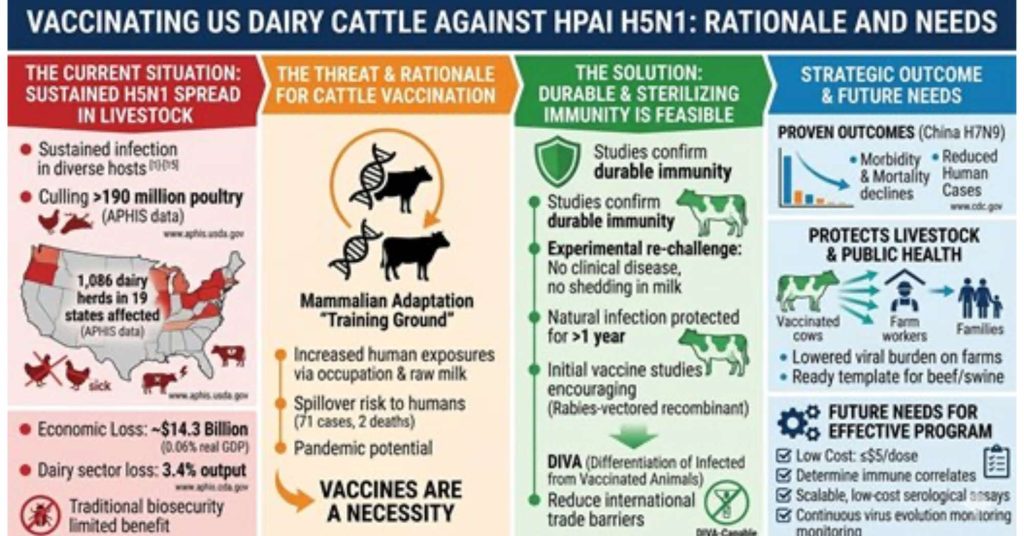
The current wave of H5N1, which has decimated U.S. poultry flocks to the tune of 190 million birds since 2022, took an unexpected turn in 2024 by jumping into dairy cattle. Today, the virus has reached more than 1,000 dairy herds across 19 states, resulting in a $14.3 billion hit to the U.S. economy.

In a recent commentary in The Journal of Infectious Diseases, Dr. Gregory Gray, a professor at The University of Texas Medical Branch, warns that dairy cattle are now acting as a mammalian “training ground” for the virus.
“Every H5N1 infection in animals or humans is like a roll of the dice,” Gray stated. “Most of the time, nothing major happens. But the more chances the virus gets, the greater the risk that the virus will become more dangerous to animals or humans”.
The Argument for Vaccination
Public health and veterinary experts are increasingly advocating for the vaccination of dairy herds to “turn down the volume” on the virus. The strategy is based on several key findings:
- Strong Immunity: Studies indicate that cattle infected with H5N1 can develop durable, sterilizing immunity that protects them for over a year.
- Promising Trials: Early field trials for rabies-vectored H5N1 vaccines in cattle have shown protective antibody levels for at least 200 days.
- DIVA Technology: New vaccine platforms allow officials to Differentiate Infected from Vaccinated Animals (DIVA), which is critical for maintaining international trade and ongoing surveillance.
- Existing Infrastructure: Most Indiana farms already use routine vaccinations and detailed records, meaning a rollout wouldn’t require starting from scratch.
While human cases in the U.S. remain rare and generally mild, there have been at least 71 confirmed human infections and two deaths. In Indiana, health officials are actively monitoring farmworkers who have been exposed to test-positive animals, though no evidence of human illness has been linked to the virus in the state to date.
Monitoring and Biosecurity in Indiana
The USDA has implemented a National Milk Testing Strategy to monitor the nation’s milk supply and dairy herds. In Indiana, Grade A dairy farms in designated control areas are subject to testing, and lactating dairy cattle must have a negative test before any interstate movement.
BOAH and industry consultants continue to stress that biosecurity is the primary weapon against H5N1. Recommendations for Indiana producers include:
- Limit Entry Points: Ideal farm layouts should have only one controlled entry point.
- Dedicated Loading Zones: Move cattle in areas away from the main farm to prevent outside trucks from contaminating your property.
- Sanitization: Standardize the sanitization of boots and equipment for all workers and visitors.
“Vaccines don’t have to be perfect to be useful,” Dr. Gray noted. “If they reduce disease and transmission, that’s a win”. For Indiana’s cattlemen, the decision to modernize their defense through vaccination may soon be the next step in protecting the state’s agricultural legacy.