

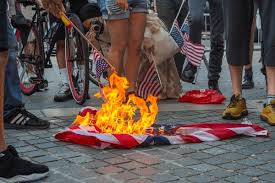
WASHINGTON, D.C. – President Trump signed an executive order on Monday that directs the Department of Justice to investigate incidents of flag burning, claiming the act incites violence and riots. The order directly challenges the 1989 Supreme Court decision in Texas v. Johnson, which established that flag burning is a form of protected speech under the First Amendment.
“All over the country they’re burning flags,” Trump said Monday in the Oval Office, declaring it an important issue. “When you burn the American flag, it incites riots at levels that we’ve never seen before. People go crazy. In a way, both ways. Some are going crazy doing it. There are others that are angry, angry about them doing it.”
The administration will try to prosecute other crimes, like violent crimes, hate crimes, and crimes “against property and the peace,” as a way to deter flag burning, according to a White House fact sheet.
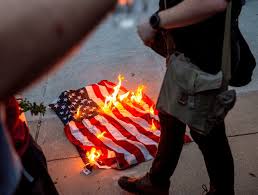
In the landmark case, Justice William Brennan wrote for the majority that “The Government cannot assume that every expression of a provocative idea will incite a riot, but must look to the actual circumstances surrounding the expression.” This legal precedent has long protected the act of flag burning as a form of symbolic protest.
Just hours after the executive order was signed, a man who identified himself as a 20-year combat veteran, Jay Carey, was arrested for setting a U.S. flag ablaze in front of the White House. U.S. Park Police confirmed the arrest, stating the individual was charged with violating a federal regulation that prohibits lighting a fire on land controlled by the Park Service, except in designated areas.
CNN captured the moment the man used a lighter to set fire to the flag he had placed on the ground in Lafayette Park. As a small crowd began to gather, Carey said he was doing it to protest Trump.
The arrest and the executive order are expected to reignite the legal and political debate over the limits of free speech and the right to protest in the United States.

