

BLOOMINGTON – On February 24th, the Bloomington Board of Public Works approved guidelines for the 2026 downtown outdoor dining season, following staff recommendations and the review process established under City ordinance.
These guidelines include language stating that Kirkwood Avenue will remain open to vehicles under a shared-street model (accommodating motorists, cyclists, and pedestrians together), while allowing food service establishments to install parklets in the parking spaces in front of their properties.
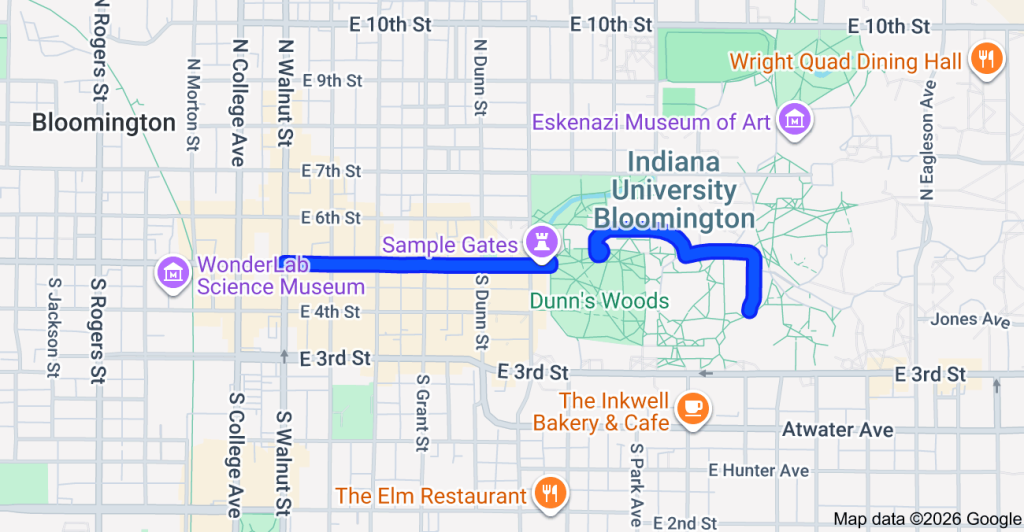
Kirkwood Avenue is a public right-of-way. As a public street, it serves restaurants, retailers, service businesses, property owners, employees, residents, visitors, delivery operations, transit, emergency services, downtown festival organizers, cyclists, pedestrians, and motorists.
Outdoor dining in the Kirkwood right-of-way began as a temporary pandemic-era measure. In subsequent years, the City evaluated corridor operations and transitioned the program into a regulated seasonal structure.
Use of the right-of-way for this purpose is governed by an ordinance adopted by the Bloomington Common Council. Under that ordinance:
- Bloomington Council establishes and may amend the governing framework
- Public Works conducts an annual operational review
- The City Engineer has the authority to recommend continuation, modification, or cessation based on operational conditions
- Relevant departments participate in the evaluation
The Board of Public Works reviews the recommendation in a public meeting and determines seasonal authorization
During the 2025 season, Kirkwood operated under a full street closure model. Major programmed festivals generated strong attendance. Outside scheduled events, activity levels were lower, particularly during weekdays and non-peak hours.
There are more than 25 restaurants along the corridor. Five participated in outdoor street activation last year. Business survey responses were approximately evenly divided regarding continuation of a full closure. Several restaurants expressed opposition to the continued full closure.
In evaluating the 2025 season, City staff focused primarily on corridor performance and participation levels. While full closure supported well-attended festivals, it did not generate consistent daily activation across the broader business district. Limited participation and uneven weekday activity indicated that the model was not producing a sustained economic lift for downtown as a whole.
Staff also documented operational considerations associated with full closure, including delivery routing, emergency access coordination, sanitation and maintenance logistics, accessibility impacts, staffing requirements, and periods of limited activation outside peak meal hours and scheduled events.
In evaluating corridor performance, staff considered that a full 24-hour closure must operate effectively throughout all hours and days, not just during peak periods.
As a public right-of-way, Kirkwood Avenue must accommodate multiple functions, including commerce, access, safety, mobility, and public gathering. The City’s responsibility is to manage that space in the broad public interest within the constraints of infrastructure, funding, and adopted policy.
Based on corridor performance data, business participation levels and feedback, and overall community benefit, in addition to the City’s operational considerations, staff recommended continuing a shared-street model using permitted parklets rather than a full closure. The Board approved that recommendation.
The City’s adopted Transportation Plan identifies Kirkwood as a shared street. A shared street is a low-speed, typically curbless roadway designed to allow pedestrians, bicyclists, transit users, and motorists to safely and cooperatively share the same space through intentional design elements that prioritize pedestrian activity while maintaining vehicle access. Determining whether the corridor should transition to a different long-term configuration would require additional community consultation, coordination with property owners, engineering analysis, capital investment, and evaluation within the broader downtown transportation network.
The 2026 program provides for enhanced parklets with updated design and accessibility standards, continued support for major downtown festivals, targeted small-scale activations in partnership with businesses, and preparation for a comprehensive Kirkwood Corridor Study in 2027 to evaluate long-term safety, transportation function, and economic development considerations.
Work in 2026 will include continued data collection to inform the 2027 corridor study. The current structure reflects corridor performance and community access needs. The 2027 study will evaluate long-term design considerations within the broader downtown network; however, recent experience and reports indicate that full street closures outside programmed events do not produce consistent, corridor-wide economic activity. Any decisions on Kirkwood will be evaluated through the lens of overall downtown vitality, accessibility, and long-term economic resilience, rather than solely on infrastructure capacity.
The program remains subject to annual review as required by ordinance.

