


INDIANA — An alarming new study has revealed that Indiana leads the nation in the acceleration of cybercrime targeting seniors. According to data analyzed by Simmrin Law Group, Indiana experienced a staggering 324.8% increase in senior cybercrime complaints between 2023 and 2024—the highest spike of any U.S. state.
Nationwide, Americans aged 60 and older lost a combined $4.48 billion to online scammers in 2024, an average of $12.3 million stolen every single day.
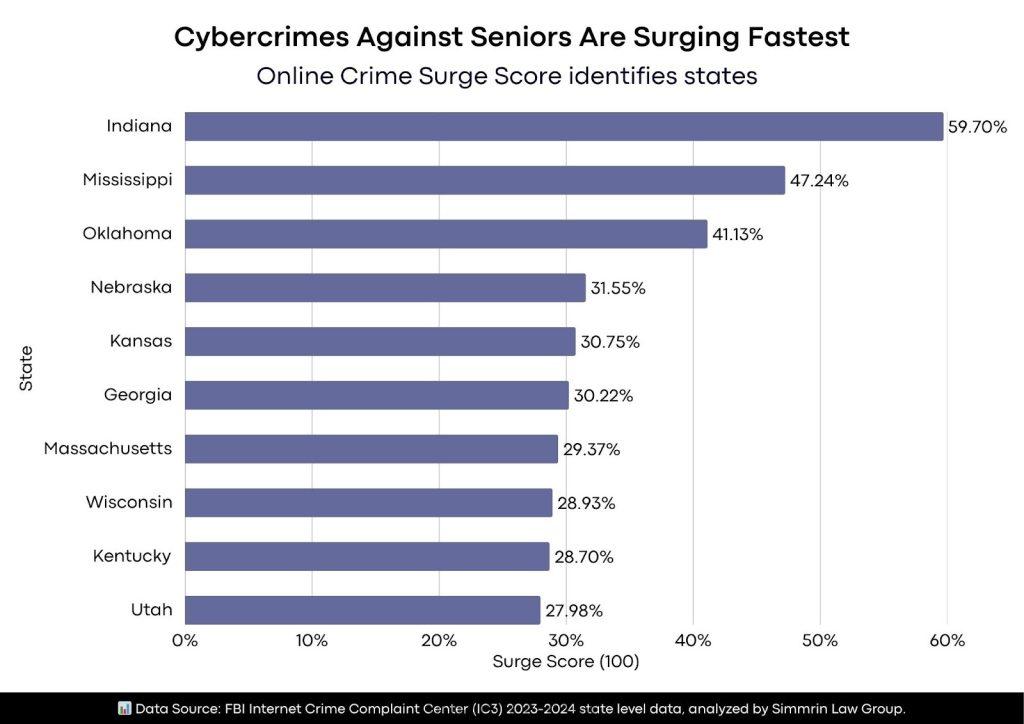
The study utilized a specialized Online Crime Surge Score, which weights the growth of complaints alongside financial losses. While Indiana saw a slight 1.6% dip in total dollars lost (falling from $37.8M to $37.2M), the sheer volume of victims exploded from 1,255 in 2023 to 5,331 in 2024.
This unprecedented surge suggests that Indiana has become a primary testing ground for high-volume, automated scams such as phishing, tech support fraud, and “pig butchering” cryptocurrency schemes.
The crisis is not limited to the Midwest. Across the country, 142,970 seniors filed complaints in 2024, a 57.7% increase from the prior year.
- Highest Financial Blow: Mississippi seniors faced the most brutal financial acceleration, with losses skyrocketing 209.5% despite only a moderate rise in complaints.
- Highest Overall Losses: California remains the most targeted state in terms of total volume, with seniors losing $834.1 million in 2024 alone.
- Costliest Scams: Texas seniors reported the highest average loss per incident at $51,704, indicating a prevalence of sophisticated, high-value investment fraud.
“These numbers represent real people—grandparents and neighbors—who trusted digital systems and were betrayed,” said a spokesperson for Simmrin Law Group. “Cybercriminals are systematically targeting seniors in states with limited digital literacy resources.”
According to FBI IC3 data, the majority of senior losses are driven by three specific categories of crime:
- Investment Fraud: Particularly cryptocurrency scams, which accounted for over $9 billion in total national losses.
- Tech Support Scams: Fraudsters posing as reputable companies like Microsoft or Apple to gain remote access to computers.
- Romance/Confidence Scams: Emotional manipulation used to convince victims to wire money for “emergencies.”
With Indiana currently ranked as the second most vulnerable state for cybercrime per capita, state and federal officials are urging families to adopt the “SLAM” method for every unsolicited communication:
- S – Sender: Check the email address carefully. Does it match the official domain?
- L – Links: Hover your mouse over any link to see the destination URL. If it looks like a string of random characters, don’t click.
- A – Attachments: Never open attachments from someone you don’t know.
- M – Message: Be wary of extreme urgency, threats of arrest, or demands for payment via gift cards or cryptocurrency.
If you or a loved one has been targeted, experts say reporting the crime is essential—even if no money was lost. Data from these reports allows the FBI to shut down “botnets” and scam call centers globally.
- File a report: Visit IC3.gov.
- Seek Guidance: Contact the AARP Fraud Watch Network at 877-908-3360.

